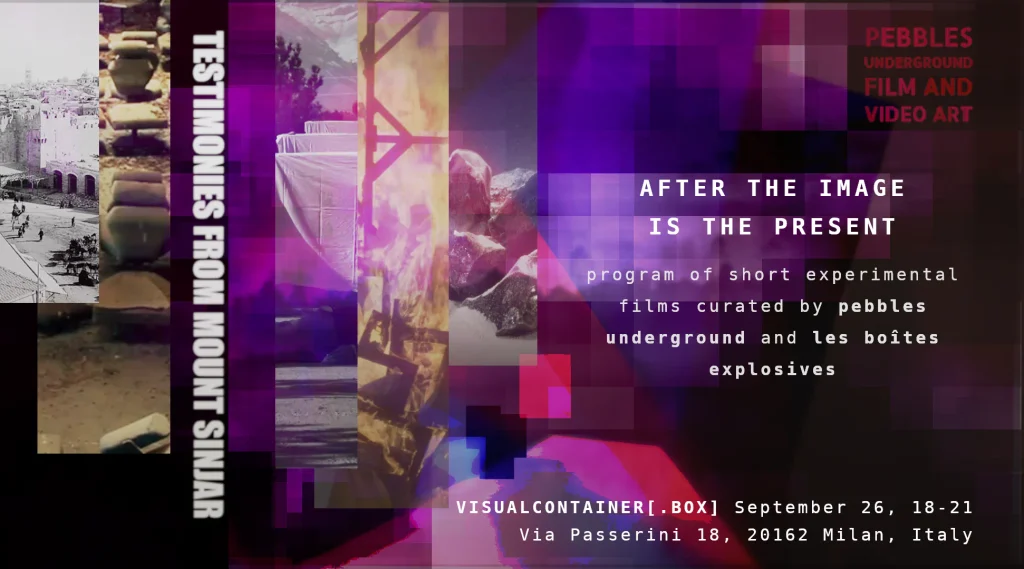
AFTER THE IMAGE IS THE PRESENT
Program of experimental short films
curated by Pebbles Underground and Les Boîtes Explosives
Presented by Visualcontainer[.BOX]
September 26, doors at 18h00, program duration: 1hr
Via Passerini 18, 20162 Milan, Italy
The stories reflected [here] do not belong safely to the past. The division of Cyprus in 1974, the crimes against humanity committed by ISIS in Iraq and Syria, the ethnic cleansing of Armenians in Artsakh, and the genocide of Palestinians in Gaza are all unfinished political histories. Their consequences, like ripple effects, change how, by whom they are remembered, denied, documented, or erased.
These histories do not belong to a concluded sequence of regional catastrophes either. They belong to a political geography in which earlier wars, occupations, and acts of destruction continue to shape what can be seen, said, and believed now. The current war of the US against Iran, although not represented in any of the films directly, is an “elephant in the room”, the tragic continuation of the program in real life.
Who records the evidence? Whose story is believed? Who gets to disappear twice: first physically, and then through the erasure of their history and culture? What happens when the present produces huge numbers of images, but they don’t necessarily lead to accountability?
The multiplication of evidence does not resolve the struggle over reality. Side-by-side the struggle for preserving political memory, the films almost embody the need to rebuild, to resist through ritual anchored in one’s own body. A fight against the Present that became an incessant producer of its own archive in real time, pouring out military statements, satellite images, phone footage, testimonies, casualty figures, intercepted communications, destroyed targets…
The open-ended finalé of the program is not a conclusion, but a refusal to conclude it. For the curators, for the artists, for the viewer.
– Text by Pebbles Underground and Les Boîtes Explosives –
AFTER THE IMAGE IS THE PRESENT
A political point of view
Alessandra Arnò
In a present crossed by conflicts that multiply and overlap — in Gaza, in Artsakh, in Iraqi Kurdistan, in a Cyprus still divided — video art asserts itself as a political instrument before it is an aesthetic one: the capacity to fix, process, and return what daily information compresses into figures and headlines. The six works in the programme do not yield to the narrative of war, but move through it in gestures, bodies, and voices: the ritual cleaning of an abandoned airport, the deliberate destruction of fifty paintings as an act of refusal against the spectacle-image of violence, the oral transmission of trauma across generations, hands kneading bread while a siege unfolds outside, scripts that gather survivors’ testimonies, up to a work that refuses closed narrative altogether, leaving the viewer responsible for its meaning.
No gaze remains neutral in this programme. If the closing work of the selection — signed jointly by Nima Nikakhlagh, Iman Tash, and Amir Sharif — entrusts its meaning entirely to the subjective interpretation of whoever is watching, it is because this principle runs, more or less overtly, through the whole selection: the representation of conflict is not exhausted in the image; it is completed in the gaze that receives it, and therefore in the responsibility of whoever chooses to look, to look away, or to deny that there is anything to see. The relationship between work and viewer is where the politics of the image plays out. To look, in this sense, is already a form of positioning. Whoever bears witness ceases to be a mere audience and becomes party to what they have seen: it is precisely in this shift — between spectator and witness — that experimental moving image reclaims a function that the distracted consumption of the contemporary image has steadily eroded.
Each work constructs a different degree of proximity and responsibility: some ask the viewer to dwell in the dead time of an abandoned place, some confront them with the absence of a deliberately destroyed image, some compel them to listen to a voice without the comfort of an explanatory image, some hand over the construction of meaning entirely. In no case does the viewer receive a ready-made impression: they are asked to work through it, to remain within the discomfort of the question rather than the comfort of an answer. This operation comes at a cost — it demands time, attention, and a willingness not to be immediately reassured — but it is here that the agency of a work engaging the viewer visually, emotionally, and intellectually can be measured.
This link between representation, spectator, and politics becomes explicit when someone attempts to erase it by force. This was evident only days ago at the Venice Film Festival, where NAZA, the documentary by Yuval Abraham and Rachel Szor, received twenty-five minutes of applause and the Special Jury Prize, only to be branded “obscene” by Israel’s culture minister, who threatened to strip the filmmakers of their citizenship, accusing them of treason. The short circuit is telling, and worth underscoring: censorship, when it declares itself openly, almost never succeeds in making an image disappear — on the contrary, it confirms its power, turning a film into a case, a gaze into a threat to be neutralised. It is the same logic, inverted, that Parham Ghalamdar stages by burning more than fifty of his own paintings — works already exhibited in international institutions — in response to the unbroken flow of images of violence from Gaza: if authority attempts to make an uncomfortable image disappear by accusing whoever produced it, the artist chooses to make it disappear himself, withdrawing it from the regime of the image-as-spectacle before anyone else can neutralise it by reducing it to evidence. In both cases, destruction—suffered or chosen—does not close the matter; it makes it more visible, shifting the conflict from the image’s content to the right to show it.
More often, though, concealment needs no dramatic gesture, no threatening minister, no fire. It works through accumulation, absence, neglect—and in this slower, less spectacular form, the concealment of the image and the concealment of guilt blur into one another until they become the same thing. The Nicosia airport that Andreas Savva cleans, seat by seat, has stood still since the Turkish invasion of 1974: history made it invisible simply by ceasing to pass through it, and with it made invisible the responsibility for a division that Europe now treats as a closed matter, even though that border remains the only one still under military occupation on the continent. There is no declared guilt in an empty building—only its absence from the news, and it is precisely that absence that the work puts back into circulation. In the same way, the voice that Nour entrusts to a family in The Nakba Across Generations does not narrate a concluded event. Still, what is passed down, generation after generation, is as much trauma as institutional refusal to acknowledge continuity between 1948 and the present — a continuity that, to be denied, must first be made invisible. The hands kneading bread in Fibers, by Anna Grigorian, hold a gesture that no war bulletin records, under a siege — that of Shushi, in Artsakh — largely ignored by Western public opinion, not for lack of available images, but for lack of sustained attention; the scripts that Huner Emin gathers from survivors of crimes committed by ISIS against the Kurdish and Yazidi population give shape and voice to a violence exposed to oblivion the moment it leaves the headlines, when media urgency moves elsewhere and historical responsibility remains suspended, never fully assumed. Concealing the image and concealing the guilt proceed together, in the same movement: it begins with no longer looking, and ends with no longer having to answer for anything.
This is also why the very circulation of these works is integral to their political meaning, and why independent networks take on the task of continuing to show them, against the logic of accumulation and removal. The shared presence of bodies in front of the screen restores to viewing a collective character that the fragmented, individual consumption of images online tends to dissolve: one watches together, one can watch oneself watching, and the responsibility already discussed ceases to be merely individual, becoming, for at least an hour, shared.
It is no surprise that, faced with this double movement of removal, the selection does not answer with a single language. Ritual, iconoclasm, orality, the domestic gesture, the document, the refusal of closed narrative: these are different strategies for the same task — restoring complexity where public discourse imposes synthesis and simplification. No work in the programme gives in to the temptation of the image-as-spectacle; instead, all of them proceed by subtraction, by mediation, by slowness — which is why they become, here, an act of resistance before they are a stylistic choice.
We live in a time that has refined the instruments of concealment: not only declared censorship, but the slow erosion of relevance — the reduction of a massacre to an incident, of an occupation to a controversy, of repression to a matter of public order. In this scenario, the complexity that each work holds is not a stylistic detail, but a form of resistance to what tends to simplify, minimise, render acceptable. The mere presence of these images, shown and discussed, takes ground away from normalisation: not because they resolve a conflict, but because they keep intact the part that no synthesis, and no authority, can erase. It is in this obstinacy — showing what one would rather make disappear, answering for what one would rather leave without guilt — that the civic responsibility of our gaze is measured today.
September 2026
© Alessandra Arnò
Director
Visualcontainer Italian videoart Platform
VisualcontainerTV Online International Videoart Platform
Visualcontainer[.Box]
PROGRAM
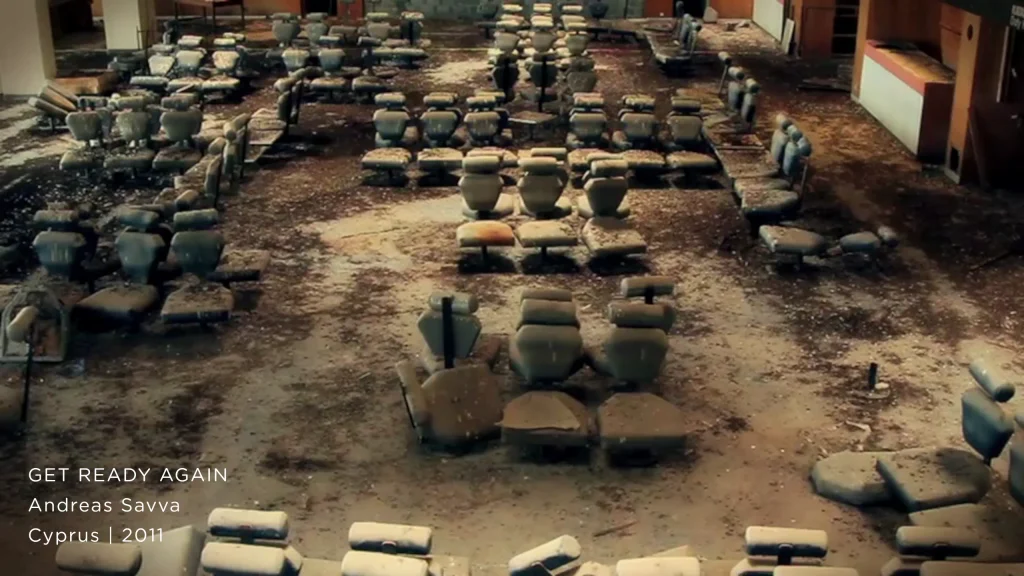
GET READY AGAIN by Andreas Savva | Cyprus | 2011 (02m20s)
Silent, Color
The video performance is shot at the abandoned Nicosia Airport, which terminated its function soon after the Turkish invasion of Cyprus in 1974. After that it was mainly used as the headquarters of the United Nations Peacekeeping Force in Cyprus. We view the artist in the symbolic act of cleaning the chairs of the abandoned airport as if it gets prepared to restore its function.
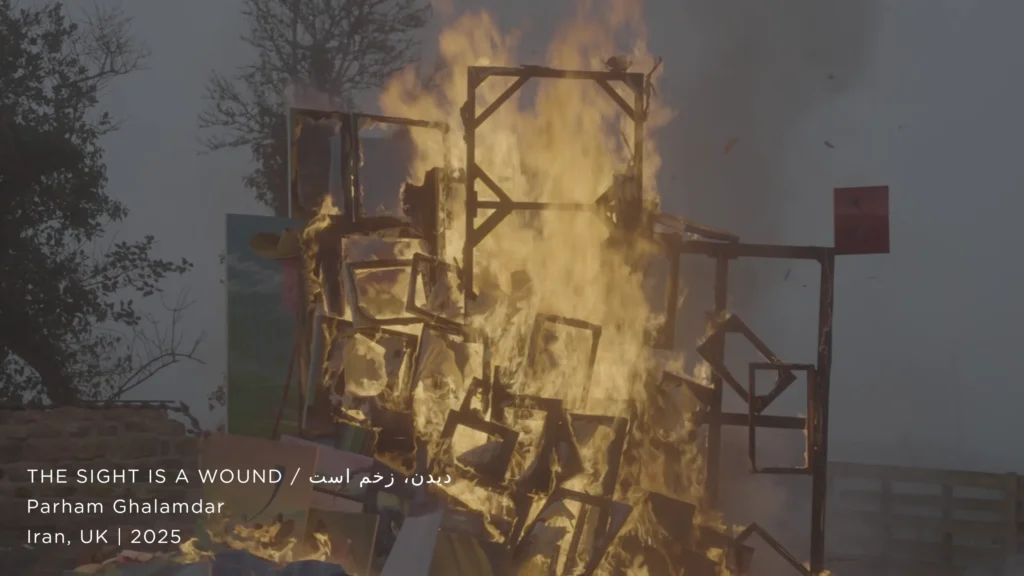
THE SIGHT IS A WOUND / دیدن، زخم است by Parham Ghalamdar | Iran, UK | 2025 (06m48s)
Sound, Color
A six-minute experimental video-poem confronting the ethical crisis of image-making in the digital age, particularly in response to the unfolding genocide in Gaza. In an act of aesthetic refusal, artist Parham Ghalamdar burns over 50 of his own paintings—works previously exhibited in renowned institutions worldwide—as a personal and political gesture against the overwhelming flood of atrocities visualized through screens.
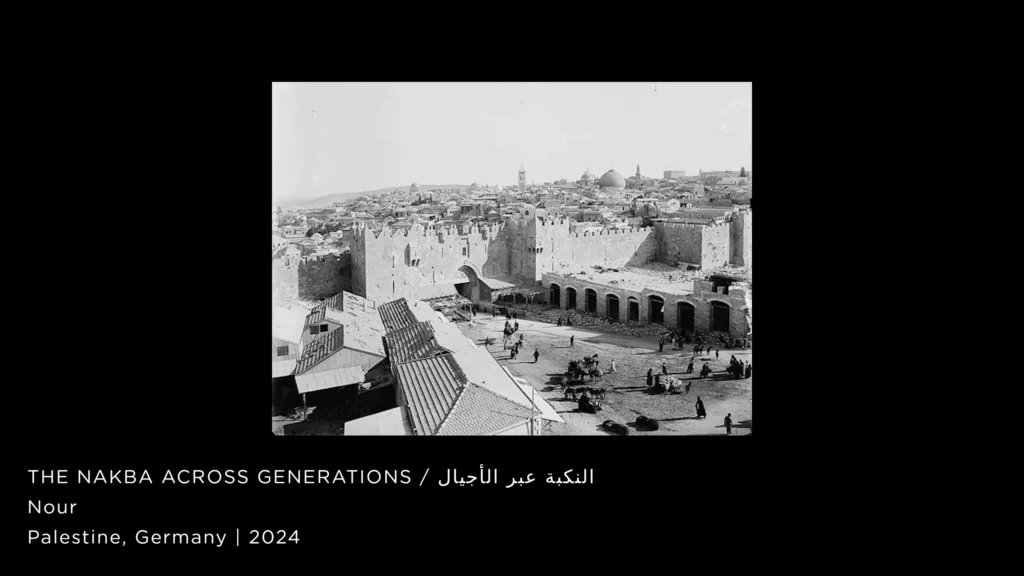
THE NAKBA ACROSS GENERATIONS / النكبة عبر الأجيال by Nour | Palestine, Germany | 2024 (11m)
Sound, Color
Experimental documentary recounting the multifaceted stories of the Nakba through the lens of a family. By weaving personal narratives with historical events, it attempts to reflect the broader, collective trauma experienced by Palestinians and also draws an important parallel to the “second” (if it ever really stopped since 1948…) Nakba happening to the people of Gaza as we speak.
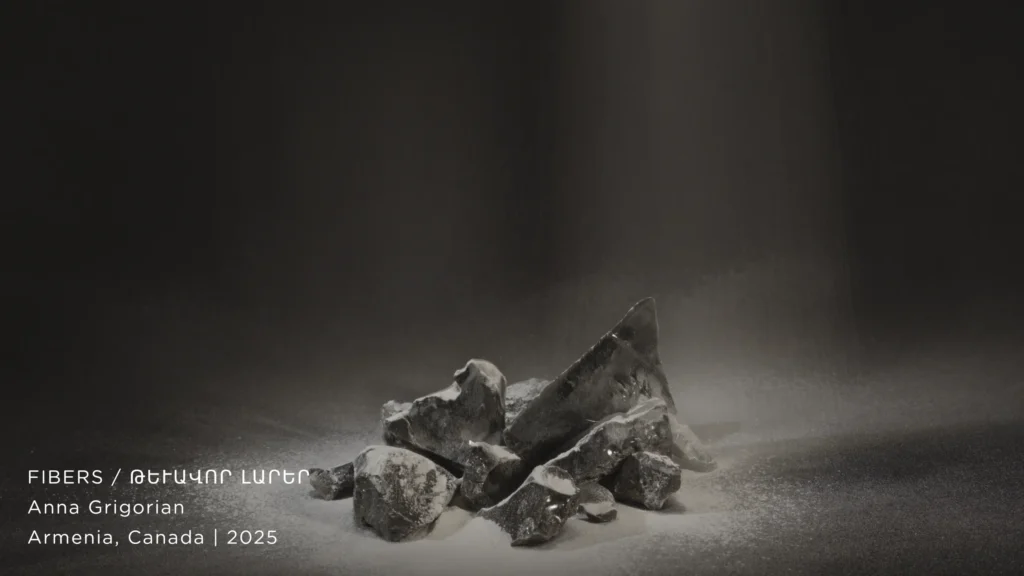
FIBERS / ԹԵՒԱՎՈՐ ԼԱՐԵՐ by Anna Grigorian | Armenia, Canada | 2025 (15m30s)
Sound, Color
Experimental essay documentary blending voiceover testimony, performative studio imagery, and tactile close-ups of the narrator’s hands making zhengyalov bread to reflect on memory, resilience under siege, and daily life during the war in Shushi (Artsakh/Nagorno-Karabakh).
TESTIMONIES FROM MOUNT SINJAR / دیدەڤان ژ چیایێ شنگارێ by Huner Emin | South Kurdistan (North Iraq), USA (07m50s)
Silent, Monochrome
“Testimonies from Mount Sinjar” is a multidisciplinary project focused on crimes against humanity committed by ISIS members in Iraq. Featuring a series of written film scripts of crucial, desperate, and traumatizing moments that survivors suffered under ISIS’s captivity.
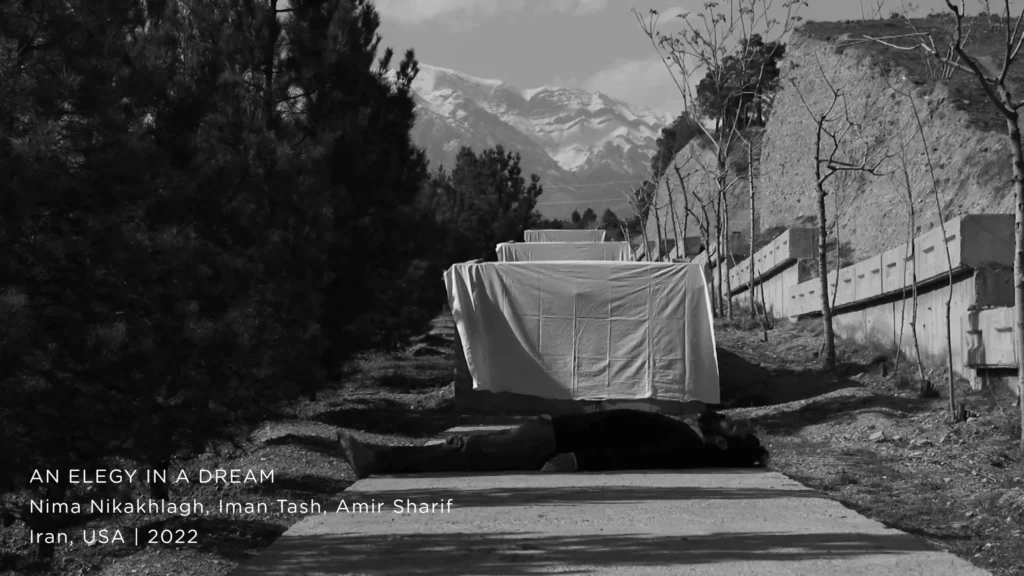
AN ELEGY IN A DREAM by Nima Nikakhlagh, Iman Tash, Amir Sharif | Iran, USA | 2022 (18h36s)
Sound, Monochrome
As a non-narrative audio-visual experience, the film itself is not fully realized until it is individually and subjectively interpreted by each viewer.
The main idea of the film is not to tell a story nor to simply entertain. We feel it is important that the audience not have been given any specific directions before viewing. When each audience member adds their own stories to the film, based on their own experiences, it is the moment when the making process of this film is realized. It is not until the viewer takes the film into their own consciousness that it becomes – in this way, cinema is a collaboration between the filmmakers and the audience.